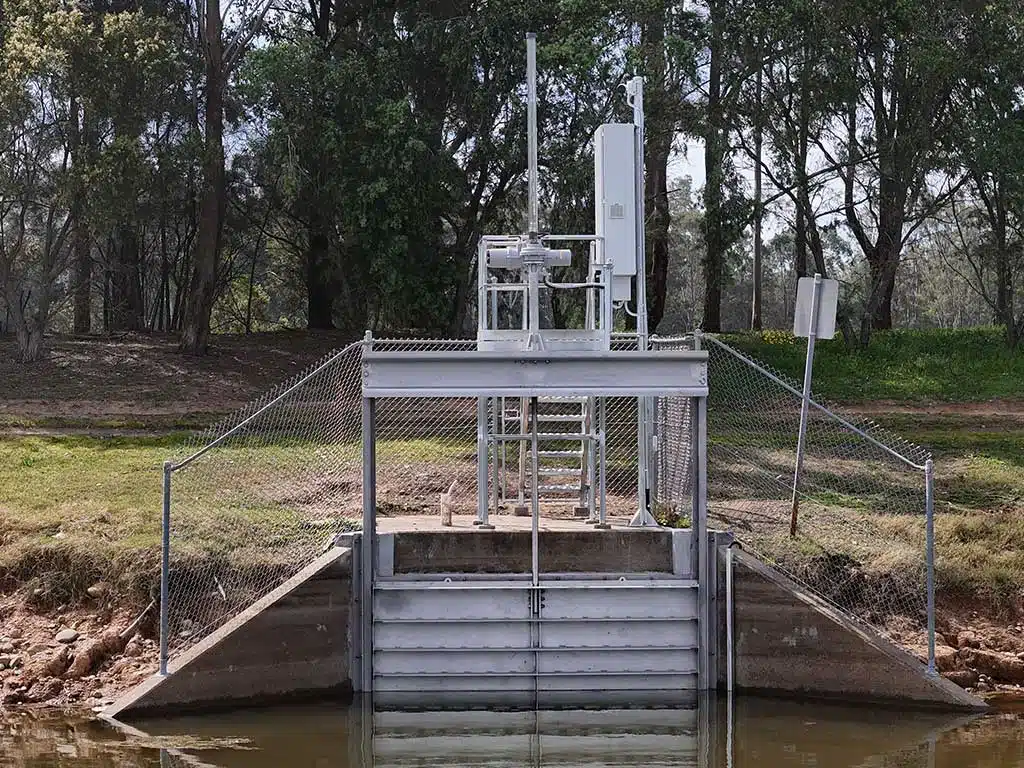
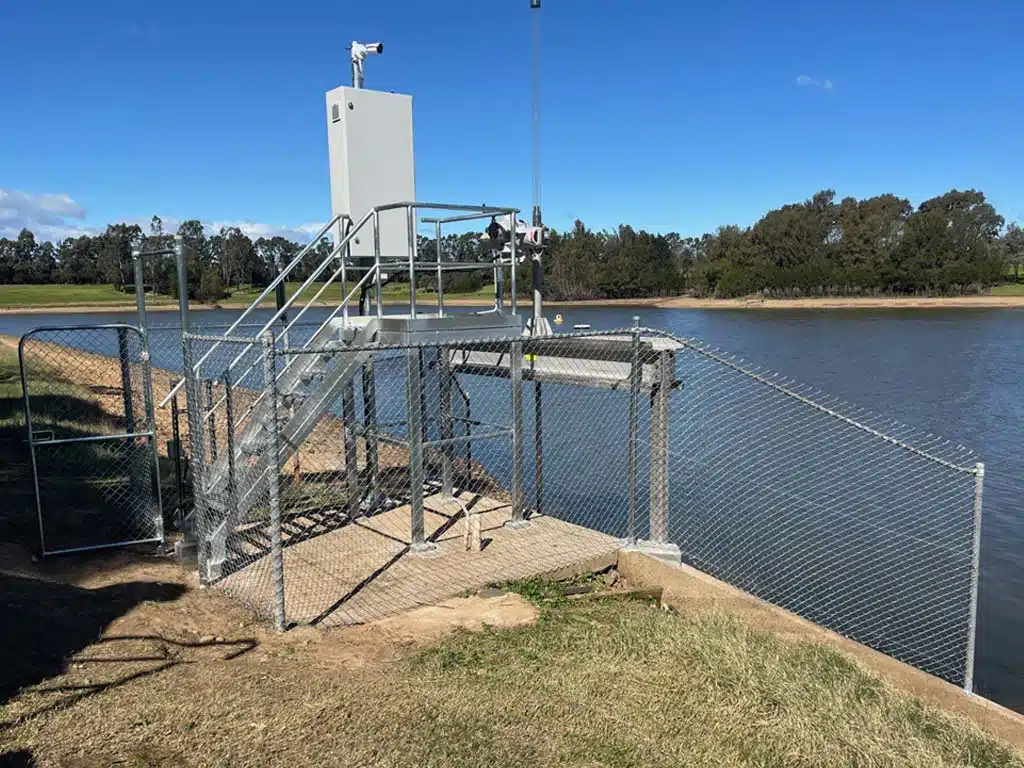
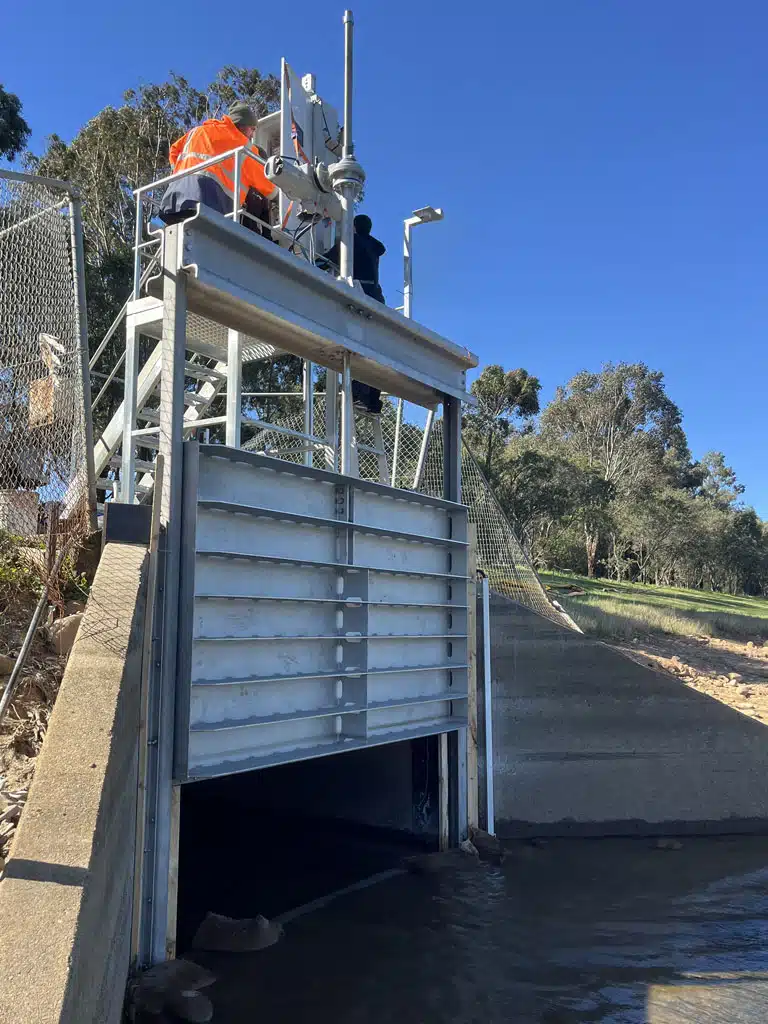
AWMA has supplied an advanced automated undershot gate to enhance flood management operations at the Sydney International Regatta Centre (SIRC), located within the Penrith Lakes Scheme. This critical upgrade replaces an ageing, manually operated sluice gate that had reached the end of its serviceable life, addressing long-standing challenges in flood control, operational safety, and environmental protection.
Background
The SIRC and surrounding eastern catchment lakes were originally constructed in the mid-1990s when the local catchment was largely peri-urban. Stormwater runoff was relatively minor, with much of the rainfall infiltrating the ground. However, extensive urban development and increased industrialisation in the area, has significantly altered catchment hydrology. The proliferation of hard surfaces has increased runoff rates into the Regatta Centre, placing greater demand on its flood management infrastructure.
Historically, water flows between the Final Basin and the Competition Lake were controlled by a single manually operated sluice gate. This gate, installed over 30 years ago, required manual cranking via gears and a handwheel located at the outlet of a 3.0 m wide x 1.8 m high concrete culvert. Due to corrosion, deformation of the gate leaf, and mechanical wear, operation had become increasingly difficult and unsafe, particularly during flood events when the pad was overtopped. The gate could only be partially opened (approximately 100 mm) to prevent downstream scour, which restricted outflow rates and resulted in overtopping events in the Final Basin during heavy rainfall.
Project Objectives
The Office of Strategic Lands (OSL), identified the need to replace the existing gate with a modern, automated water control solution that could:
-
Improve flood management responsiveness during storm events
-
Reduce WH&S risks associated with manual operation
-
Enable remote operation and control
-
Maintain optimal water quality through managed flow releases
-
Ensure long-term durability and compliance with environmental objectives
AWMA Solution
AWMA was engaged to design, manufacture and supply a custom-engineered TLF undershot gate to meet the specific hydraulic, environmental, and operational requirements of the site.
The new undershot gate solution, designed and manufactured from grade 316 stainless steel, replaces the ageing manual sluice gate. Measuring 3m wide by 5m high and engineered for a 50-year design life, the automated system provides both on-site and remote operation. The technology enables precise water level control, sending real-time alerts directly to operators’ phones or tablets, and integrates remote CCTV monitoring to ensure a safer, faster, and more efficient flood response.
As this waterway is regularly accessed by the public, remote monitoring and control allow operators to visually confirm the area is clear and safe before any gate operations are undertaken.
Technical Overview
-
Model: AWMA Undershot Gate (TLF configuration)
-
Material: Grade 316 stainless steel
- Gate Structure: 3300 mm (W) x 5000 mm (H)
-
Aperture Dimensions: 3050 mm (W) x 1800 mm (H)
-
Design Head: 5.0 m maximum on-seating head pressure
-
Mounting Configuration: On-seating position, installed on the upstream headwall of the existing culvert
-
Seal Type: Uni-directional, resilient seals affixed to the frame and gate leaf
-
Actuation: 240 V AC electric actuator with integral handwheel for manual override
-
Control: Remote operation with compatibility for telemetry, CCTV monitoring, and control system integration
-
Safety & Accessibility: Actuator, gearing, and manual control positioned above the maximum water level for safe operation from an elevated platform
-
Design Life: 50 years
The AWMA undershot gate operates via a rising spindle mechanism for precise flow regulation. The actuator and gearbox assembly are engineered to limit rim pull effort to below 180 N at full design head, ensuring efficient and safe manual operation if required.
Operational and Environmental Benefits
The automation of the AWMA undershot gate enables responsive flood management, allowing operators to safely adjust water levels remotely based on live catchment data or visual verification via CCTV. The enhanced remote functionality provides real-time operational oversight, improves safety for site personnel and the public, and ensures proactive flood response capabilities.
The improved hydraulic control also supports water quality objectives, allowing controlled detention times for sedimentation and bacterial reduction before discharge. By moderating outflows, the new gate helps minimise downstream erosion and infrastructure damage that had previously been exacerbated by uncontrolled overtopping events.
Outcome
The automated water control gate represents a significant improvement in the resilience and functionality of the Penrith Lakes flood management system. It enhances safety for operational staff, provides greater flexibility in flood response, and ensures the long-term integrity of critical waterway infrastructure.
This installation reflects AWMA’s ongoing commitment to delivering innovative water control solutions that combine robust engineering with environmental stewardship and operational reliability.